
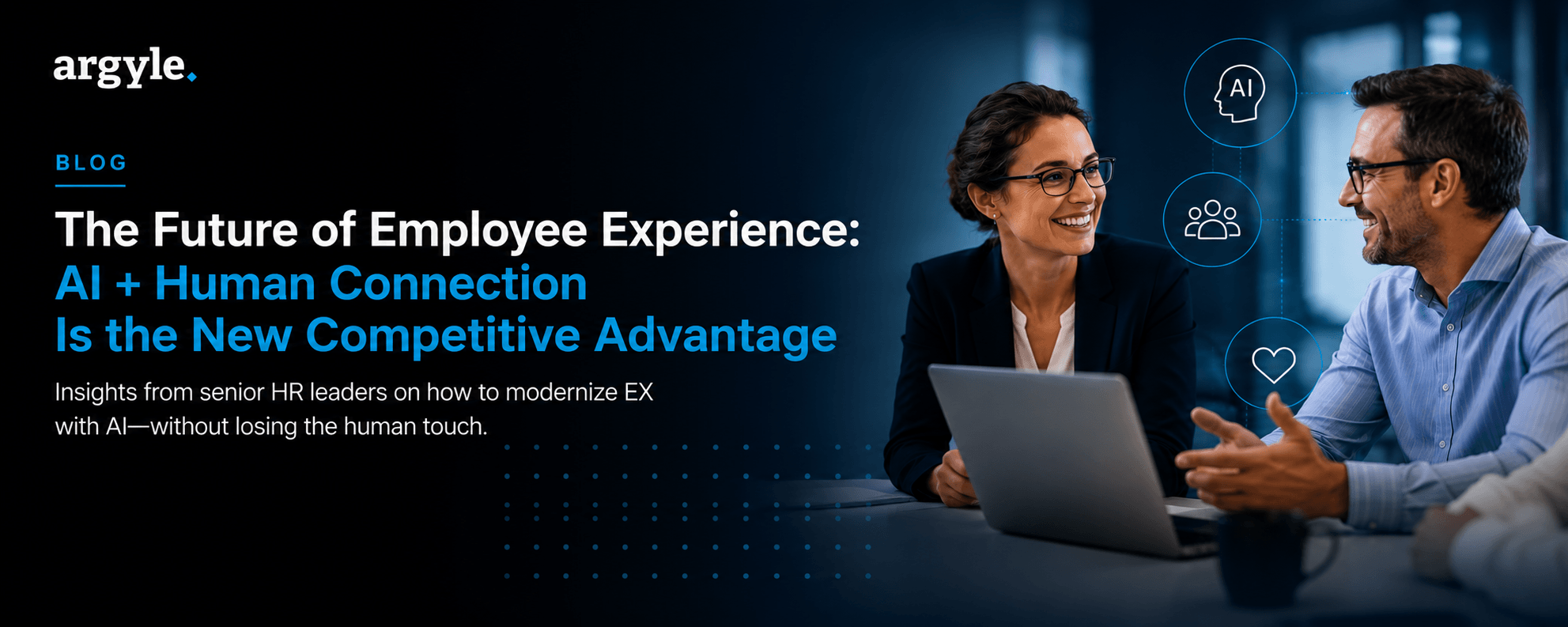
AI Employee Experience: 5 HR Trends Driving Enterprise Transformation
AI employee experience is becoming one of the most important strategic priorities for enterprise HR leaders.
Artificial intelligence is dominating executive conversations across industries, but inside HR organizations, the real challenge is balancing automation with trust, personalization, and human-centered workforce engagement.
Senior HR leaders are under increasing pressure to modernize employee experiences while protecting engagement, culture, and workforce confidence. Employees want faster, smarter, and more personalized workplace experiences — but they do not want HR to feel robotic.
This tension is creating one of the biggest strategic opportunities in workforce transformation today.
Organizations that successfully combine AI efficiency with human-centered experience design are emerging as leaders in employee engagement, workforce retention, and organizational agility. Meanwhile, companies that fail to balance both risk creating disconnected employee experiences that damage trust, adoption, and long-term retention.
This was a central theme explored during a recent executive discussion hosted by Argyle Executive Forum in partnership with Conduent, where senior HR leaders examined how AI is reshaping workforce experience strategies across enterprise organizations.
The conversation revealed a broader market shift: enterprise HR leaders are actively searching for technologies, strategic partners, and employee engagement solutions that modernize workforce experiences without sacrificing human connection.
Why AI Employee Experience Is Reshaping HR
A year ago, most conversations around AI in HR focused heavily on efficiency and automation. Today, executive priorities are evolving.
Enterprise HR leaders are now asking:
- How do we scale personalization across the workforce?
- How do we maintain employee trust during AI adoption?
- Where should automation stop?
- What moments still require human interaction?
- How do we improve adoption of digital HR tools?
This evolution matters because it signals a major shift in workforce transformation strategy. The winners in enterprise HR will not simply be the organizations with the most AI capabilities. They will be the companies that design better employee experiences.
What Enterprise HR Leaders Are Getting Wrong About AI Employee Experience
One of the biggest mistakes organizations make is assuming AI alone improves employee experience.
In reality, poorly designed automation often creates:
- Frustration
- Low adoption
- Employee distrust
- Increased disengagement
- Process confusion
- Fragmented workforce experiences
Many HR teams are discovering that automation without empathy creates more friction, not less. This is why human-centered design is becoming increasingly important across enterprise HR strategy.
The strongest AI employee experience strategies combine:
- Intelligent automation
- Personalized self-service
- Omnichannel engagement
- Data-driven workforce insights
- Human escalation paths
- Experience-led design
Organizations moving fastest in this area are no longer treating HR as an administrative function. They are treating employee experience as a business growth strategy.
Employee Experience Is Becoming a Boardroom Priority
One of the clearest insights emerging across executive HR discussions is that employee experience is no longer isolated to HR departments. It now directly impacts:
- Workforce retention
- Productivity
- Organizational agility
- Employer brand
- Talent acquisition
- Customer experience
- Business performance
This is why AI employee experience conversations are attracting increased executive attention. Leaders recognize that workforce experience directly influences how organizations compete.http://According to <a href=”https://www.gartner.com/en/human-resources” target=”_blank”>Gartner HR research</a>, employee experience and workforce technology are becoming critical priorities for enterprise organizations.
Employees now expect workplace experiences to mirror consumer-grade digital interactions. They expect:
- Speed
- Accessibility
- Convenience
- Personalization
- Seamless digital support
This shift is forcing enterprise organizations to rethink outdated HR models and invest in more adaptive workforce technologies. According to themes discussed during Argyle’s executive forum with Conduent, organizations are increasingly redesigning employee journeys around flexibility, accessibility, and moments that matter.
That transition is creating demand for:
- HR technology modernization
- AI-enabled workforce platforms
- Employee engagement solutions
- Intelligent self-service systems
- Workforce analytics tools
- Strategic transformation partners
For enterprise solution providers, this represents a rapidly expanding market opportunity.
Why Sponsors Should Pay Attention to AI Employee Experience Trends
One of the biggest challenges in B2B marketing today is gaining meaningful access to senior decision-makers. Executive HR leaders are overwhelmed with vendor outreach, generic content, and transactional marketing.
What cuts through the noise are high-value conversations centered around real business challenges. That is why executive forums and thought leadership communities are becoming increasingly valuable.
When enterprise leaders gather to discuss workforce transformation priorities, sponsors gain something more valuable than impressions: they gain relevance.
The Conduent and Argyle Executive Forum discussion brought together senior HR executives focused on:
- Workforce modernization
- Employee experience transformation
- AI adoption
- HR technology strategy
- Human-centered organizational design
These are precisely the audiences many enterprise brands struggle to reach through traditional demand generation channels.
Why Insight-Driven Executive Content Performs Better
Most B2B content fails because it sounds promotional instead of insightful. Executive audiences are not looking for marketing messages. They are looking for:
- Market intelligence
- Peer perspectives
- Strategic guidance
- Industry validation
- Emerging trends
- Actionable insights
That is why insight-driven executive content consistently outperforms generic lead-generation campaigns.
The most effective thought leadership programs:
- Create peer-to-peer credibility
- Position sponsors alongside industry conversations
- Generate higher-quality engagement
- Improve executive trust
- Extend content value beyond a single event
Rather than relying on broad awareness campaigns, enterprise brands can participate directly in conversations already shaping HR transformation priorities.
For additional workforce transformation insights, explore Argyle Executive Forum’s executive HR discussions and thought leadership content.
The Future of AI Employee Experience
AI adoption in HR will continue accelerating. But the organizations gaining the most traction will not simply be the loudest voices discussing AI. They will be the companies helping enterprise leaders solve workforce transformation challenges in practical, human-centered ways.
That requires:
- Executive education
- Peer-driven conversations
- Strategic insights
- Industry collaboration
- Credible thought leadership
As HR leaders continue navigating AI transformation, employee experience modernization, and workforce engagement challenges, the demand for high-quality executive conversations will only increase.
Brands that invest early in these discussions will be better positioned to:
- Build executive relationships
- Improve market visibility
- Generate enterprise pipeline
- Increase category authority
- Strengthen buyer trust
Final Thoughts
AI is fundamentally changing employee experience, but the future of workforce engagement will not be fully automated. The organizations that succeed will be the ones that combine intelligent technology with intentional human-centered design.
Employees want speed, personalization, and convenience — but they also want empathy, trust, and meaningful support. Balancing those expectations is becoming one of the most important strategic priorities for HR leaders.
As enterprise organizations continue investing in AI-driven transformation, human-centered employee experience will increasingly define which companies attract, retain, and engage top talent most effectively.
Want to connect with senior HR leaders discussing AI employee experience and workforce transformation? Explore Argyle Executive Forum sponsorship opportunities and executive events.


